Words are Pictures’ blog

Icon

Just another WordPress.com weblog

Fantasy League ads

Thought I might share some behind the scenes shots of a recent project I worked on for CHI & Partners. The ‘Loyalties tested’ campaign for FantasLeague.com pokes fun at the idea of fantasy football whereby, if you’re really into it, you’ll find yourself cheering for players from other teams.

FantasyFootball_01 
Creative team Matt and Wayne (http://www.mattandwayne.co.uk/) came up with the idea of adding apologetic caveats to football chants and asked me if I could come up with a way of representing this. Thinking back to my own experiences at matches I remembered fondly seeing huge guys with messages daubed across their chests and backs and thought this might be a nice way to get the idea across. 

Photography by Conor Masterson.

Filed under: Making of...

You can’t make people read, but you can make them want to (unabridged)

Creative Review have published an article by me this month. For space reasons they had to edit it slightly so here’s the full version for anyone who’s interested.

Over the last 7 years working as a designer and typographer in a variety of agencies above, below and through the line (whatever that is anymore), I’ve heard it said that good typography is invisible. That if a good typographer has done their job, you won’t know they’ve done anything at all. It’s perfectly true in many cases of course – and something I’ve riffed on myself in the past – but it’s no longer a maxim that I’m particularly comfortable in subscribing too.

Typography has always been perceived as something of a quiet art – a dark art even. Practiced by bespectacled men in darkened rooms, squinting at bezier curves on out of date monitors and using out of date software (miss you Fontographer). Fastidious men like Jan Tshichold and Eric Gill who wore suits to work and sported immaculate side partings – no bad thing. The craftsmanship and dedication that designers like this brought to the party can’t be under-estimated, but, in my opinion, neither is it something that can be rested on.

At the risk of generalising (as it was a time of much experimentation) the designers of that particular generation (or at least the ones I mentioned above) were champions of clarity and legibility. It was something they strived for – partially because to achieve it with the printing equipment they had at the time was quite something. Neatness of line, crispness of form and the immediate recognition of each letter and the context it has been placed in were their goals. It is something that has been taught in all (good) design schools for decades now and remains singularly the most important string in the designer’s bow. If you can’t work with type, you can’t call yourself a designer, it’s as simple as that. It sorts the wheat from the chaff; the dedicated few from the weekend Mac-jockeys, downloading free Photoshop brushes and bad freeware fonts by the bucket load.

‘Legibility’ is also a word that clients like and enjoy using. All the time, in my experience. “I can’t read it. Make it bigger. It’s not legible enough”. It’s one of those little power displays that lets you know that they know some stuff about what you do – so don’t you dare try and blind them with science. Unfortunately, it’s a term they too often confuse with readability – which is something else entirely – and also something they place far too much emphasis on. A dozen or more times I’ve had ideas rejected for their lack of legibility, regardless of how interesting and intriguing they might be.

A lot of things move more than they used to. Even posters move now; AdShells and billboards replaced by huge screens, full TV ads being shown on cross-track projections on the underground. Everywhere you look, something is bouncing around trying to grab your attention. TV’s have always moved but now the little ads on the side of your browser window jump about and invade your screen space with full motion video and the like. Everything moves. Because of this, straight typography has had a lot of competition in recent years and to a certain extent a lot of the established rules have been cast aside, particularly in new media: it’s a fact universally acknowledged that most type on the web is shit – although it is getting better. Carson may have been a little premature in his proclamation that print was dead all those years ago – and with it, all the rules we have come to acknowledge and obey – but it has certainly taken to it’s bed with a mug of Lemsip. It’s time, therefore, for typography to step up and to move on if it’s to avoid being forgotten and becoming a trampled wallflower.

In advertising there are still rules, visually speaking. Most of them regarding the immediacy of communication, particularly above the line (if there is still a line – the road becomes less clearly defined round these parts but that’s another essay entirely). Apparently you have less than 5 seconds to get your message across – hence your average D&AD annual will consist of dozens of variations on the ‘Witty juxtaposition of images (visual one-liners like brains made out of popcorn, two Weetabix making a heart shape, that kind of thing) + logo and strapline in the bottom right hand corner’ formula.

This is something else most clients are all-too-happy to tell you they know all about. They’ve had workshops to the effect. A man in a roll neck told them that it worked. It is, unfortunately, an industry-destructive way of working. Students look at the annuals. Students see what wins the awards. Students think this is what advertising is all about and forget how to write for advertising. Typography plays less and less of a role. I lose my job. Or become a re-toucher.

It’s become a kind of visual shorthand – read ‘lazy’ – for advertising or adverts and, in my opinion, has become all too easy to ignore. I can’t be bothered to ‘get it’ anymore and these days, those kinds of ads tend to wash over me in the same way as SALE signs, neon letter X’s in Soho and most things with skulls do. The problem, it seems, is that at some point, we have become ashamed to ask people to read what we’re saying. I had some work for a major book retailer rejected recently for being too wordy. A bookshop. Too wordy. Doesn’t quite marry up does it? Apparently, they’re having to dumb down in the face of increased competition from online retailers and need to get people through the door and clever posters in the windows scare people. When was being clever ever considered scary? I’ve received far too many briefs from creatives asking me to set the end line ‘as small as we can get away with’. It’s a tried and tested template for sure but, from a design point of view, it’s also tired and testing – and has made viewers and consumers visually lazy. There will always be the few champions of the long-copy ad – a breed previously thought to be extinct but which enjoyed a brief revival recently, something the recession has quickly snuffed out – but for the most part there is a tendency to take the easier way out in terms of concept and art direction. And that’s exactly what it is. Pictures are easier to comprehend than words. It’s why books for young children are full of pictures. You’d think we’d grow out of it but apparently not.

I’d like to propose, in these interesting times, that we stop taking the easy way out. That we don’t ’set it as small as we can get away with’. That creatives aren’t ashamed of being wordy or verbose and that, rather than assume people will only look at your ad for 5 seconds, give them something that they want to spend 5 minutes looking at and reading and understanding. What’s better? A perfectly legible and communicative poster that everyone can read but no one is interested by, or a convoluted, well put together and interesting piece of typography that demands you stop and look at it and which a handful of people will?

We’re all in the same boat here and only ideas will save you, so why not try something different? Some wordplay. A poem. A story. A statement. Say something about the brand you’re advertising. What have you got to lose? If no one’s buying anything, no clever juxtaposition of images is going to change their minds. People might actually appreciate being spoken to in a normal tone of voice. While everyone else is shouting, speak quietly and calmly. If they listen they listen, if they don’t it’s clearly not for them.

I genuinely believe words can be as visually engaging as any image – if used and treated correctly – and a piece of typography that might not be immediately ‘legible’, may still turn out to be more effective at getting the right kind of people to stop and stare. Surely it’s better to connect with 1 consumer effectively than to have 20 consumers see your ad, get it and walk on? A picture may paint a thousand words, but conversely, with a thousand words, who needs pictures?

-

Craig Ward /
Words are Pictures

Craig Ward is a designer and typographer at CHI & Partners and is also represented by Debut Art.

Filed under: General

Making the Creative Review subs page…

I first came across the graphic, real world, perspective-defying work of Swiss artist Felice Varini a couple of years back, and had been aching to try my hand at something similar ever since. The brief was to ‘Make Creative Review a part of your world’ so, suddenly I had my opportunity.

The technique we used employs ‘anamorphic perspective’ theory and, in an interview with Varini he says he uses ‘nothing more than simple maths’ to create his compositions. The maths turned out to be rather less simple than I’d hoped, however (http://www.generativeart.com/salgado/anamorphic.htm) so I emailed him for any more advice he might have. His answers – not helped by broken English I hasten to add – were pretty elusive.

I wanted to create something clean and graphic and slightly out of place in a real world setting and the reflective properties of fluorescent gaffer tape turned out to be the perfect material. It presented it’s own problems when it came to lighting the shoot as it was giving off more light than it was absorbing so we had to try a few different techniques. We also tried dressing the ’set’ with a few other items (and legs, courtesy of Katie) before settling on the final piece.

Filed under: Making of...

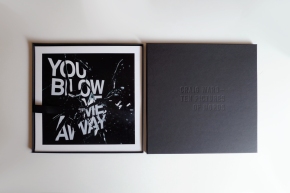
The making of ‘You Blow Me Away’

As one of my more ambitious pieces I thought I’d open with a behind the scenes look at how my recent collaboration with photographer Jason Tozer was created.

I conceived the piece towards the end of last year and set about looking for photographers who might be able to help me realise it. Jason appeared to be the go-to man for breaking things beautifully so I dropped him a line proposing we get together. We reasoned it could be a beautiful thing but, with no real reason to make it happen, decided to let it be for the meantime. Then, in January, I was approached by the organisers of The Art Mosh – a traveling exhibition in it’s second year who wanted me to create 10 new pieces for the end of March. Suddenly I had my reason…

We got the guys over at K2 to screen print my typography onto 20 sheets of 7mm glass. Jason put up the studio and lighting hire and we holed ourselves up in his Old St studio and broke glass for a few hours. I was delighted with the results. The images, whilst at once kinetic and exciting, are also studies in the boundaries of legibility as we managed to capture the glass at various stages of destruction.

I hope you like.
 

Filed under: Making of...

The Words are Pictures blog

Irrespective of whether you’ve followed the link from my site or stumbled across this by accident, hello. I’m not entirely sure what I’d like to use this blog for but I think it’s reasonable to expect a variety of musings on typography and my work in general alongside a couple of case studies of pieces I’m particularly proud of. Hope to see you here again soon.
Craig Ward/
Words are Pictures

Filed under: General